
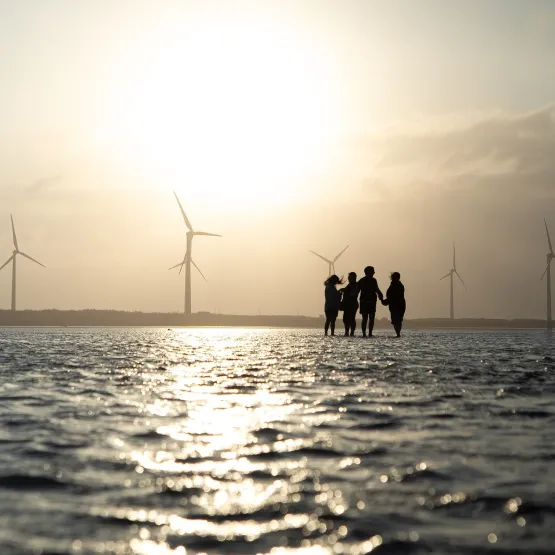
Our team calls have developed an unofficial ritual. Someone joins, there's a moment of small talk, and inevitably someone asks: “What's the weather like where you are?” It's a reasonable question when your colleagues are spread across New Delhi, Amsterdam, London, New York, Bangkok, and Nairobi. The answers, naturally, vary. What doesn't vary is the subtext.
It's getting hot.
Hotter than it should be, arguably faster than we expected, and in places that perhaps weren't supposed to feel it this soon.
I've been at the World Benchmarking Alliance, as the Civil Society Engagement Lead, for a little over a year now, and in that time, the temperature has been both a literal context and a persistent metaphor. We work on assessing how the world's most influential companies are navigating the transitions the world needs: to net zero, to nature-positive, to socially just. We do this, in part, because the evidence that something has to change is increasingly hard to argue with. You can feel it: in the weather, in the widening gap between what companies commit to and what workers and communities actually experience, and in the quiet urgency of every conversation we've had in the last year.
For nearly a decade, WBA assessed companies through a systems transformation lens with benchmarks across climate, social, nature, food and agriculture, digital inclusion, and others. Each was built for depth and specificity – to go granular on what companies were doing in a particular domain and make their performance visible in the public eye. That work mattered, and the expectations it built, still do.
But as our understanding of how these topics and crises connect has deepened, so has our conviction that measuring them in parallel is no longer enough.
We have, thus, evolved our thinking towards something that highlights how these systems interact: a single integrated framework that assesses companies on whether they have a credible, coherent plan to navigate all three transitions together. And for the past several months, we've been consulting the world on our proposed methodology, on how the assessment should look like, and importantly, what it must ask of companies.
We are calling it the Integrated Transition Assessment.
The case for integration
The instinct behind the Integrated Transition Assessment is simple: Climate, nature, and social transitions are not separate problems with separate solutions. A company's climate plan cannot be read in isolation from its approach to land and water. An energy transition that leaves workers and communities behind is not just. And when artificial intelligence reshapes labour markets and energy systems simultaneously, a framework that treats these as separate questions is missing something important.
Integration is no longer a design preference or a choice out of convenience. It is an honest recognition of the world we live in. And quite frankly, the need of the hour.
What we heard
We launched the consultation for our proposed Integrated Transition Assessment methodology in April 2026. What followed was something I didn't fully anticipate... perhaps because I'm still learning the scale at which we're operating, and the scale at which the problems sit.
Close to 200 organisations engaged in the consultation overall - companies, investors, governments, standard-setters. My focus was civil society organisations (CSOs), and that alone could fill several blogs.
The CSOs that we were grateful to interview in this process reflect the full breadth of what civil society looks like: a global coalition monitoring civic freedoms across 175 countries; an agroecology network working with smallholder farmers in a dozen African nations; a human rights network spanning 23 Asian countries; labour rights researchers who have spent years in garment factories in India and Bangladesh documenting what happens when accountability systems fail; an Aboriginal agricultural economist farming on Worimi Country in New South Wales, who understands land stewardship not as a sustainability commitment but as an inheritance. I spoke to partners who have run campaigns that made international headlines; and then some who work in communities that form the very foundation of global supply chains yet remain separated from the companies they produce for by miles and worlds.
All of them made time to provide us thorough feedback, and many came forward voluntarily. Some were engaging with us for the first time and thus came with a fresh outlook; some had history with our earlier benchmarks and came with institutional memory and pointed questions. Some sent a polite email and completed a fifteen-minute survey. Others requested a call and spent an hour - sometimes the entire hour - on a single indicator.
Humbling, isn’t it?
One conversation was almost entirely about grievance mechanisms. It circumvented discussing corporate accountability in the abstract, or transition planning as a concept, and focused on the specific question of how a worker in a garment factory can raise a complaint without fear. How many steps it takes. Whether the mechanism is accessible in the language they actually speak. Whether the company genuinely wants to hear the answer. Whether the factory management has internalised the need and realised the value of addressing the concern.
Another was about living wages, as a structural problem, beyond setting a target that time might swallow. If the purchasing practices of a global brand are driving down the factory gate price, then is asking suppliers to pay a living wage a fair commitment? It's a request that almost contradicts itself.
Another touched on Free, Prior and Informed Consent: the principle that communities have the right to say No to decisions that affect their land and rights. In theory, this is well-established international law. In practice, we heard about farmers in East Africa signing contracts they didn't fully understand, for land use that would bind their community for forty years, because the accountability systems that should prevent it are not yet credible enough to hold.
We heard about civic space, the quiet precondition for all of this. Whether communities are free to organise, to speak, to push back. Whether the conditions for meaningful engagement actually exist in the countries where these transitions are happening. And we heard from those working to build food coalitions, agroecological supply chains, and living income pathways in places where the global food system extracts the value and leaves behind the risk.
What struck me, across all of it, was both the diversity and depth of the issues.
Each of these topics (grievance mechanisms, living wages, FPIC, responsible AI, stakeholder engagement) is a world unto itself. People have dedicated careers to understanding a single one of them. And here we are, trying, in one framework, to hold all of them together. It is anything but easy, but it’s also high time we formally recognise that the connections between these issues are real, and pretending otherwise is its own kind of failure.
The feelings I’m left with
For many reasons, building the Integrated Transition Assessmen, as I shared before, has been humbling. And I don't mean it in the polite, performative sense that all of us, sometimes are guilty of using this word, but genuinely humbling.
We have had to make design choices that are consequential - which indicators to include, how to weigh them, what evidence standard to apply - and we have made them in a world that is moving fast, with political headwinds, with imperfect data, and with a genuine plurality of views about what corporate accountability should require.
It was challenging.
What has fuelled the process, though, is a simple collective realisation. All of us working in this space - from civil society organisations to investor coalitions, regulatory bodies, standard-setters - have our own approach to holding companies accountable. We sometimes ask for different things, or the same things differently, and we often defer to different articulations, through different channels. The consultation became, unexpectedly, a moment to find the common thread, that convergence on what companies must ultimately do.
And we realised what we already knew - that there is power in alignment and repetition.
When the same expectation arrives from a union organiser in Bengaluru, an investor in Singapore, a rights defender in Nairobi, and a regulator in Brussels, it stops being one organisation's ask and starts becoming the floor i.e. the minimum the world is willing to accept. I believe the organisations that gave us their time, their scrutiny, their scepticism, and occasionally their frustration, did so because they saw that possibility. That the Integrated Transition Assessmen, if done right, could be one more place where those voices land together.
There is something to be said for building a framework with stakeholders and companies, rather than for them: the questions get harder, and our experience is testament that the answers get better.
Now, what comes next
Come November 2026, we will publish the final methodology.
It will not be perfect. No methodology ever is. But it will have been shaped - in part by companies and governments, and in part by civil society, lawyers, trade unionists, investors, researchers and human rights defenders who cared enough to tell us where we were getting it wrong. And we have valued each piece of that collective wisdom, especially the uncomfortable pieces.
When the calls start again in the autumn, with someone asking what the weather is like, or what the news is carrying this time around, and someone else hoping, for once, that the answer is a little cooler, I hope we will have built something that earns that hope. Something that is, to put it plainly, honest about what it is trying to do, and why it matters.
The temperature is rising.
The question is whether the accountability is rising to meet it.
Latest Updates


Subscribe to stay informed on our work
Keep up to date with all the latest from World Benchmarking Alliance