The decisions that will shape the global transition

The 2030 reality
While targets have raised ambition and accountability, the test is how companies respond when many will fall short.
The risks linked to climate change, nature loss and social inequality are more visible, and more consequential, than ever. Extreme weather is disrupting supply chains, ecosystems vital to industry are deteriorating, and workers and communities are bearing the costs of a transition meant to benefit them. These pressures are accelerating with the rise of AI, which is profoundly reshaping energy demand, labour markets and society all at once.
2030 has long stood as the deadline for corporate sustainability targets, set against the same horizon as the United Nations’ Sustainable Development Goals (SDGs). However, our benchmarks and insights show that most of the world’s largest companies are unlikely to meet the targets they set and progress on the SDGs remains devastating slow.
When these targets were set, 2030 sat comfortably over the horizon. The ambition was right and the commitment real. Over the past fifteen years, building on decades of research and collaboration, common frameworks, standards and measurement tools have made corporate performance more transparent. Targets have become auditable numbers, and performance can be judged topic by topic. Yet, despite widespread commitments and targets, the gap between what companies say and do is widening – and this gap has carried little consequence in today's economic and geopolitical environment, making it harder for companies to justify the required investments.
Until now, we have asked companies: “Have you set the right policies, commitments and targets?” In the coming decade, the question we will need to answer is: “How are you going to achieve those commitments and targets, and are you prioritising them in your business and investment decisions?”. Today’s measures of corporate progress were not built to answer it. What we need is a way to understand and reveal which companies are genuinely making a credible transition, and how far the rest still have to travel.
Many companies have shown that credible climate action is possible. The same now needs to be applied to people and nature, integrated into planning, decision-making and action from the start.
Choices and connections
Credible transition plans depend on seeing how climate, nature and social decisions shape one another.
The impacts of climate change, nature loss and social inequality will not be experienced in isolation, and they cannot be solved that way either. Yet companies often manage them in separate workstreams, making decisions one topic at a time. This creates a strategic blind spot.
We have become better at measuring individual topics, with great depth of knowledge and insight into their associated impacts, risks and opportunities. What we now need is a way to measure the connections and the choices between them, so companies can prioritise and focus their activities and investments.
A nature-restoration project can strengthen ecosystems, but if local land rights are overlooked, it can undermine livelihoods and trust. A company that secures critical minerals for clean technologies without strong safeguards may reduce carbon exposure while increasing risks to ecosystems, workers and local communities. Oil and gas companies can have all the proper human rights policy and procedures in place, but what does this mean if their core business continues to contribute to climate change, the biggest human rights violation of our time?
Insights from our 2026 Benchmark Hub show the consequences of decisions made in isolation.
The 2,000 companies we assessed generate USD 53 trillion in revenues and account for 54% of global emissions. They directly employ 107 million people and support a further 550 million livelihoods through their value and supply chains. Their collective power is undisputed − their decisions can help drive climate solutions, restore nature, and ensure prosperity for all.
- The nature blind spot. Companies that treat climate and nature as separate workstreams risk undermining the natural resources their transition depends on. Of the 750 companies in our 2026 Nature Benchmark, 66% identify some nature-related risk, but only 42% take concrete action and just 9% quantify the potential impact on their operations, finances or reputation. Yet decisions designed around both climate and nature can strengthen resilience and create value; but this connection remains largely unseen.
- The social cost of transition. A transition that leaves the workforce behind risks losing the trust, stability and capacity needed to ensure timely and just progress. Our 2026 Just Transition Assessment of 1,600 real economy companies and 400 financial institutions found that just 5% integrate the impacts on workers and communities into their climate transition plans, and only 4% set time-bound, measurable targets to manage them. Support for the people most affected is thinner still: only 10% of companies commit to reskilling or upskilling, and just 6% commit to job creation. The challenge is not simply to strengthen labour disclosure, but to ensure that investment in decarbonisation carries a significant enough allocation to support the people expected to deliver it.
- Where supply-chain risks compound. A single sourcing decision can compound risks across labour conditions, ecosystem health and emissions. When companies manage these issues separately, the resulting operational, financial and reputational exposure travels across the supply chain. The 2,000 companies we benchmarked reach more than 550 million people, over 110 countries and are responsible for around 70% of emissions in sectors such as food and agriculture. Yet only 10% assess human rights risks in those chains, only 20% trace products to understand nature impacts, and only a small minority disclose meaningful Scope 3 emissions data. Just 1% manage all three together. The challenge is not simply better data on individual issues, but the ability to see and manage their combined effects.
Where these connections are missed, risks and potential opportunities for value creation remain hidden and the ability for connected solutions is out of reach. Our current measurement tools see each topic in high resolution but barely capture the interactions between them. The trade-offs happen in the space between benchmarks, precisely the space no current benchmark looks at. As a result, the hardest and most consequential decisions a company makes are the ones we have the least evidence about.
Seeing the whole picture
The Integrated Transition Assessment brings separate measures into one view of a company’s choices, trade-offs and progress.
We are building the Integrated Transition Assessment Framework to help companies address the decisions that will shape the transition and allow stakeholders to understand these decisions and their impact. It does not replace existing measures or weaken their rigour. Instead, it brings them into a single view which spans climate, nature and social issues, and follows a company's path from plans to implementation and delivery.
That view preserves depth on each topic, while showing how progress in one area changes the picture elsewhere. It’s not about producing more data but more so about using the data already being collected to understand what drives a credible transition, and what blocks it.
Integration is not just about creating a horizontal overview between their commitments and targets on climate, nature and people. Companies need to ensure these commitments and targets are vertically integrated into business planning and decision-making. That is why the ITA will also look at capital allocation, governance, supply chain engagement, as well as the development of sustainable products and services. This demonstrates whether a company is meaningfully positioned to deliver the transition.
AI and digital technologies are increasingly central to how this transition unfolds. While these tools can accelerate progress across climate, nature and social outcomes, their deployment also creates new environmental and social pressures: from energy and resource dependency, to impacts on jobs and human rights. The ITA therefore treats AI not as a standalone topic, but as a cross-cutting driver whose effects must be anticipated and governed across all three transition dimensions.
Taking this approach can be uncomfortable. An integrated view exposes where progress on one topic has come at the expense of neglecting another; tensions that separate scorecards allow companies to keep apart. But the same view that reveals hidden costs can also identify genuine co-benefits. Weighing trade-offs and co-benefits across climate, nature and social action is what makes a transition plan credible, and what helps prevent it from unravelling in execution. The ITA holds companies to account, and spotlights the frontrunners already proving a credible transition is possible.
For companies, the ITA will deliver clarity across frameworks, helping them understand what needs to change, in what order, and where the greatest risks and opportunities lie. For governments and financial institutions, it will provide a more comparable view of corporate risk management and real-world exposure. And for civil society, it will offer the evidence to demand more than targets and hold companies to account for delivery and impact.
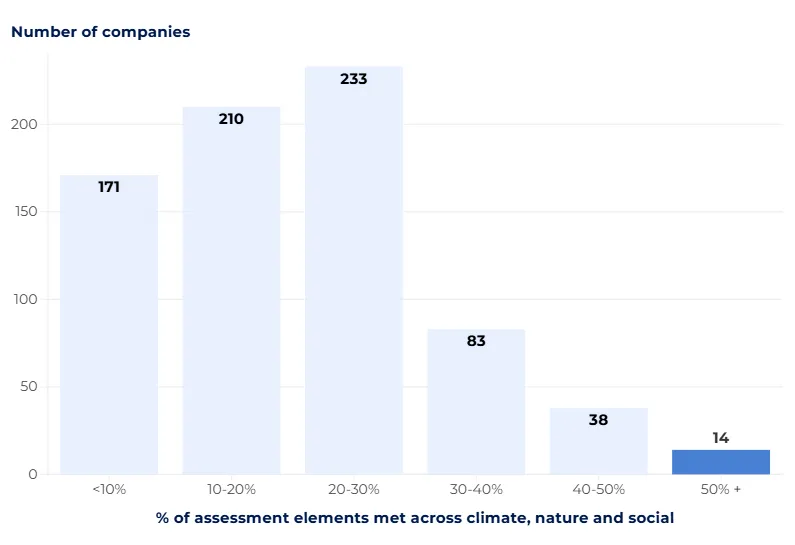
If the ITA sets the bar for what an integrated transition looks like, just 14 of the 750 companies assessed have cleared it
To support the development of the ITA methodology and test our thinking, we mapped the element-level results of WBA's 2025 assessments of 750 companies (spanning extractives, food and agriculture, consumer goods and heavy industries, and covering climate, nature and social topics) to the proposed ITA indicators. We used approximations where the 2025 benchmarks had no like-for-like element, asking one simple question: How would companies have performed on the Integrated Transition Assessment based on our current data? We found:
- Integration remains rare and companies fall short across all three dimensions.Current data demonstrates that giving balanced consideration to climate, nature, and social factors is still the exception rather than the norm across global sectors.
Just 14 of the 750 companies assessed meet even half of the elements across climate, nature, and social. Early progress toward an integrated transition is limited to just a handful of frontrunners, including BASF, Bayer, Heineken, JDE Peet’s, Kerry Group, Holcim, Michelin, Nestle, Norsk Hydro, Orsted, Pirelli & C, Puma, Rio Tinto, and Vattenfall.
- Climate scoring is somewhat ahead of nature and social. This difference is likely a reflection of how much more mature climate expectations and reporting frameworks are compared to broader sustainability metrics.
- European-headquartered companies outperform across all three dimensions. While European firms lead on integrated performance, those in South Asia lag furthest behind, showing significant regional gaps in transition readiness.
The ITA is deliberately ambitious and will be a vital tool for companies to see their plans and actions in the context of a credible transition. These findings show how far most have to travel, but a small group of frontrunners shows it can be done.
Why this matters now
As 2030 approaches, the quality and consequences of corporate decisions matter more than ever.
With many targets set to be missed, the next era will not be defined by who sets the boldest ambitions, but by how companies navigate the hard trade-offs and their ability to stay the course as we continue to face economic and geopolitical headwinds. The Integrated Transition Assessment is built to turn that reality into progress by giving companies, investors, and society the decisive data and insights needed to drive this integrated transition.
Latest Updates



Subscribe to stay informed on our work
Keep up to date with all the latest from World Benchmarking Alliance