
FAQ for the Integrated Transition Assessment

About the assessment
The Integrated Transition Assessment is a natural evolution of WBA’s work over the last decade, assessing the world’s most influential companies.
We know that companies need to reduce their greenhouse gas emissions, protect and restore nature, and ensure that workers and communities are not left behind in the transition. Yet our benchmark results show an uneven picture of corporate progress across these areas: climate action is most advanced, followed by nature, while social considerations remain the least developed.
These challenges are connected and cannot be addressed effectively in isolation, as action in one area can have unintended consequences in another. For example, mining for the minerals used in batteries and solar panels can damage ecosystems and affect the land and water rights of Indigenous Peoples and local communities. Similarly, closing coal plants reduces emissions, but without early planning for reskilling and redeployment it can lead to job losses and economic decline in the regions that depend on them. The links can also be positive: protecting forests stores carbon while sustaining the livelihoods of the communities that rely on them. Effective transition plans therefore address climate, nature and social considerations together from the start.
Yet our benchmark results have shown that few companies perform strongly across all three dimensions. The Integrated Transition Assessment deliberately brings climate, nature and people together to help show where companies are making progress, where action is needed and what is expected of them.
All indicators represent specific expectations of a company and are linked to existing standards or reporting frameworks such as CSRD, GRI, ISSB, SBTi and TNFD.
The rollout of the Integrated Transition Assessment will take place in two stages:
- 2027: Companies in selected industries will receive their first assessment. These companies will be notified by email in early 2027.
2028: All 2,000 companies will be assessed, including those assessed in 2027. This means companies assessed in 2027 will receive a second assessment in 2028.
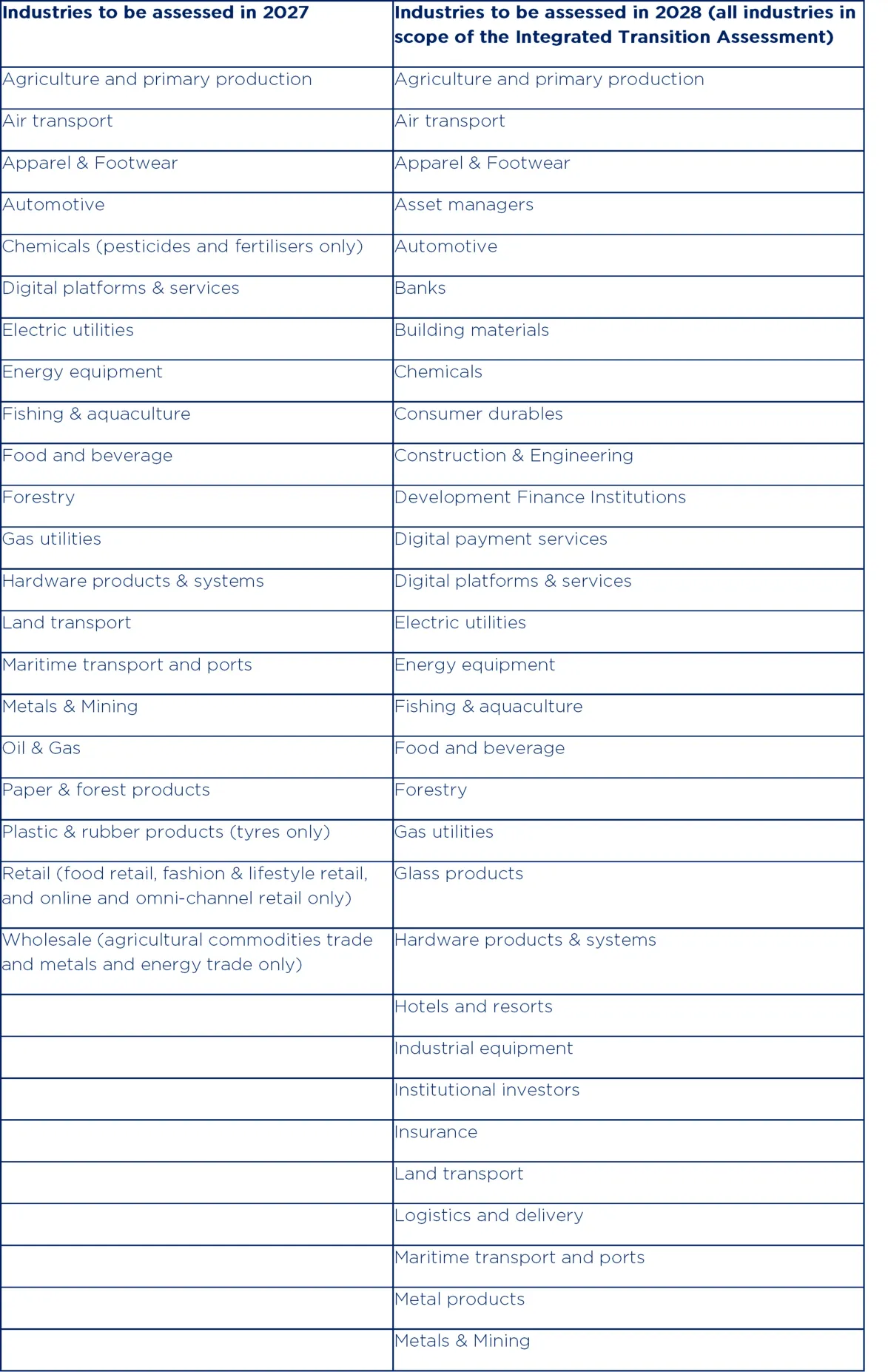
We assess the world’s 2,000 most influential companies with the greatest potential to positively or negatively impact the systems in which they operate, covering both real economy companies and financial institutions.
Companies are selected using five keystone criteria:
- Scale and industry relevance: The company has material operational scale within an industry relevant to climate, nature, social and/or digital transitions.
- Influence over transition pathways: The company controls globally relevant segments of production, services or financing that can shape transition outcomes, including through long-lived assets or transition-critical products and services.
- System connectivity: The company connects systems through subsidiaries, supply chains, capital flows or data infrastructure, extending its influence beyond its operations.
- Market and policy influence: The company can shape markets, norms, standards, or wider governance processes through its market position, industry role or policy engagement.
- Global footprint: The company has a significant presence and across multiple regions through operations, sourcing, financing or markets, particularly in developing countries.
WBA assesses all companies that meet the keystone criteria, ensuring an independent and comparable picture of corporate sustainability performance.
Companies cannot opt in or out of the assessment. WBA assesses all selected companies to ensure consistent and independent accountability, regardless of their performance or willingness to participate. Allowing opt-outs could also skew the results and undermine a fair comparison across companies.
Assessments rely entirely on publicly available information, so being assessed creates no additional reporting or disclosure requirements. However, WBA can only consider information that is publicly disclosed, so we encourage companies to publish additional information ahead of the assessment period if they want it to be taken into account.
No. The Integrated Transition Assessment replaces WBA’s separate benchmarks with a single methodology to assess the world’s 2,000 most influential companies across industries. This evolution responds to a changing context for corporate accountability.
The indicators included in this methodology were drawn largely from previous WBA benchmarks (e.g., Corporate Human Rights Benchmark, Digital Inclusion Benchmark, Financial System Benchmark), but they also include new emerging areas and reflect feedback from stakeholders during the consultation period. All indicators represent specific expectations of a company and are linked to existing standards or reporting frameworks such as CSRD, GRI, ISSB, SBTi and TNFD.
At times, WBA may conduct other research or data collection. For example, you may have received information about climate data we are collecting on behalf of Arc. However, this research and data collection exercise is separate from WBA’s Integrated Transition Assessment.
About the assessment methodology
The Integrated Transition Assessment Methodology builds on nearly a decade of WBA benchmarking. It brings together interconnected climate, nature and social issues to help companies better understand their impacts and risks, reduce duplication in reporting and strengthen accountability for progress.
The methodology combines indicators developed and tested through previous WBA benchmarks with new indicators. Refer to Table I in the Appendix of the Integrated Transition Assessment Methodology for an overview of the indicators that are new versus those that are carried over from previous benchmarks.
In the past, some WBA assessments and benchmarks had indicators that were only applicable to certain industries.
However, the Integrated Transition Assessment Methodology is industry agnostic. Each company is assigned a primary industry based on the largest share of its revenue which determines the scoring criteria that will be used in its assessment. The scoring criteria reflects industry-specific risks, impacts and operating context.
All companies are assessed on the full set of indicators:
- Universal: Some are assessed in an identical way across all industries, for example governance indicators such as board-level expertise.
- Heightened: Some apply stricter criteria to high-impact industries, so companies in those industries must meet a higher bar to receive the full score on that topic.
- Tailored: Others apply a different set of criteria altogether. This is often the case for financial institutions.
The expectations per industry are explained in the Annex of the Integrated Transition Assessment Methodology. Further details on the scoring guidelines will be published in early 2027.
Yes. High-level scoring guidelines are outlined in the Integrated Transition Assessment Methodology. More detailed scoring guidelines for companies will be published in early 2027.
About results
Of the 2,000 companies in scope of the Integrated Transition Assessment, 1,100 have been selected for assessment in 2027 based on their industry. This list will be published on WBA’s website in early 2027 and communicated to relevant companies via email. The results for these 1,100 companies will be published in early 2028 once the assessment cycle has concluded.
From 2028 onwards, assessments of all 2,000 companies across all industries will be conducted annually and published on our website.
Yes, the final assessment results will be published on the WBA website for anyone to use.
WBA releases rankings, scorecards and insights, making them freely accessible to everyone. All stakeholders including investors, companies, civil society organisations, media and governments are encouraged to use the insights.
WBA’s research and results provide companies with:
- One integrated view: Showing where your biggest transition risks and opportunities sit across climate, nature and social, rather than treating them separately
- Visibility of trade-offs: Highlighting where progress on one goal has come at the expense of another, so these can be discussed and managed at the board level and by senior leadership before they unravel a transition plan in its execution.
- Reduced burden: One streamlined assessment replaces WBA’s separate benchmarks, using information companies already publish and therefore not creating additional reporting requirements.
- Learning from peers: Comparison within and across industries shows what good practice looks like and who is leading, creating opportunities for company learning and improvement.
For further information or support in using WBA’s results, please contact the Company Engagement Team.
These assessments will also be used by companies’ stakeholders including financial institutions, policy makers and civil society organisations to inform their analysis, engagement and decision making. See different ways that WBA works with financial institutions, policymakers and civil society.
To stay up to date and work with WBA further, stakeholders may also want to join WBA’s alliance. Take a look here for more information.
Latest Updates




Subscribe to stay informed on our work
Keep up to date with all the latest from World Benchmarking Alliance
