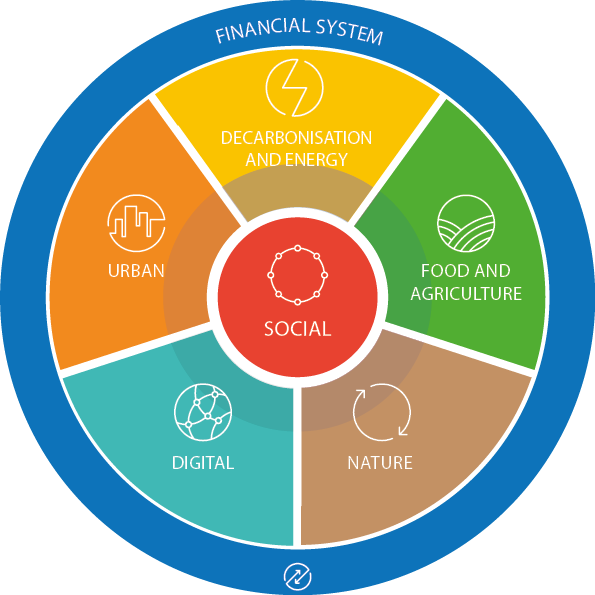
Seven systems transformations
Our planet faces enormous economic, social and environmental challenges and despite important progress, no country is on track to achieve all SDGs by 2030. Awareness is growing that the SDGs, the Paris Agreement and sustainable development beyond 2030 can only be achieved through transformational change. These transformations are essential for creating economies and societies that are truly socially inclusive and environmentally sustainable.
Tackling these systemic issues requires a systems-based approach. Achieving systems change – defined as the “intentional process designed to alter the status quo by shifting and realigning the form and function of a targeted system” – is highly complex. It demands large-scale, fundamental transformations of the societal systems that drive current environmental and social pressures. Such transformations involve changes in institutions, practices, technologies, policies, lifestyles, and ways of thinking.
Business can play a pivotal role in leading these transformations by developing sustainable, inclusive, and innovative solutions. Yet managing these deep and long-term changes requires roadmaps grounded in pathways to sustainable futures. Benchmarks developed by the World Benchmarking Alliance provide precisely such guidance. By translating societal expectations into measurable metrics, benchmark methodologies give companies a clear direction. Benchmarks and league tables then reveal where industries and individual companies stand on their journey towards a more sustainable future.
The role of companies in transforming seven systems needed to put the world on a more sustainable path


Subscribe to stay informed on our work
Keep up to date with all the latest from World Benchmarking Alliance