
Credible transition cannot be defined solely through global frameworks

Diana Ramírez, Data Coordinator at Cepei, reflects on why regional perspectives are essential to credible corporate transition, the role of data and technology in moving from ambition to action and the sustainability questions emerging from Latin America’s digital transformation.
Cepei’s role in connecting global sustainability commitments with regional action
As a Global South think tank, Cepei works at the intersection of sustainable development, multilateral affairs, digital governance, knowledge and multistakeholder collaboration. In Colombia and across Latin America and the Caribbean, we connect governments, civil society, international organisations and, increasingly, private-sector actors to bridge global sustainability commitments with evidence-informed action, stronger capacities and practical solutions grounded in local and regional realities.
Why regional perspectives are essential to credible corporate transition
Global governance and multilateralism are facing multiple challenges, including declining institutional trust, growing humanitarian needs and the increasing impacts of climate change. In Latin America and the Caribbean, corporate transition is taking place within a context marked by deep social inequalities, environmental and climate vulnerability and persistent challenges related to institutional trust and capacity.
For this reason, local and regional perspectives are essential not only to understand whether companies are making commitments, but also to assess whether those commitments are contributing to a just, inclusive and locally relevant transition.
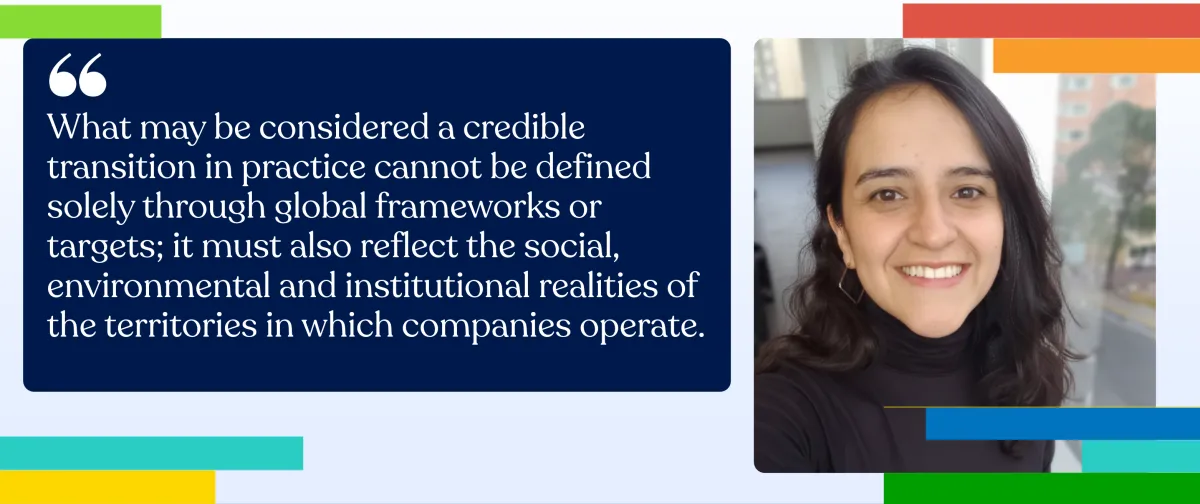
From our perspective, developing and valuing situated knowledge is therefore essential to addressing the region’s challenges. It allows us to better understand both our strengths and structural limitations, and to develop responses that are grounded in local realities while contributing to broader social and environmental sustainability goals. What may be considered a credible transition in practice cannot be defined solely through global frameworks or targets; it must also reflect the social, environmental and institutional realities of the territories in which companies operate.
Where companies can close the gap between ambition and action
One of the greatest opportunities for companies to move from high-level commitments to meaningful action lies in harnessing data and technology to make evidence-informed decisions and create public value. This is particularly relevant in the current context, as companies across sectors are rapidly adopting emerging technologies such as artificial intelligence, digital services and data-driven solutions.
However, the opportunity goes beyond adopting new technologies simply for efficiency or innovation. Companies can also consider how these technologies can contribute to broader public value, inclusion and sustainable development. Doing so requires better data, clearer ways to measure real-world outcomes and meaningful engagement with governments, civil society, communities and other actors affected by these transformations.
Cepei contributes by generating evidence, convening diverse stakeholders and creating collaborative spaces to address emerging challenges at the intersection of sustainable development and digital transformation. Through our work on data, AI, digital public infrastructure and digital governance, we help connect global debates with local and regional realities, identify practical barriers and support the co-creation of solutions that can turn ambition into meaningful, measurable and accountable action.
The sustainability and corporate accountability debates that need greater attention in the region
From Cepei’s experience working at the intersection of sustainable development, multilateral affairs and digital governance, we see two interconnected debates that deserve greater attention in Colombia and across Latin America.
The first is the intersection between environmental sustainability and digital transformation. As artificial intelligence, data centres and digital infrastructure expand, global discussions are increasingly recognising the environmental footprint of these technologies and the resources required to sustain them, including energy, water, critical minerals and land. This is particularly relevant for Latin America and the Caribbean, a region with significant biodiversity and natural resources that will play an important role in global technological and sustainability transitions. The challenge is to ensure that the expansion of digital infrastructure and innovation does not reproduce existing inequalities or extractive models, but instead contributes to sustainable development and creates value for local communities and societies.
The second is the need to strengthen how companies measure, monitor and account for their real-world impact. Beyond commitments and reporting, there is an opportunity to develop stronger systems of indicators, evidence and accountability that help assess not only business performance, but also the broader social, environmental and public value generated by corporate action. At Cepei, we have explored how Public-Private Partnerships within data ecosystems can serve as a powerful mechanism for strengthening capacities to generate evidence, inform decision-making and create social value.
For us, these debates matter now because the region is undergoing multiple transitions simultaneously: environmental, technological, economic and social. The way companies, governments and other stakeholders navigate these transformations will shape not only future competitiveness, but also benefit from these transitions and whether they contribute to more sustainable, inclusive and equitable development.
This article has been adapted from written responses provided by Diana Ramírez as part of WBA’s conversations with Allies on credible corporate transition. It has been edited and structured for clarity and readability while retaining the contributor’s perspectives in their own words. Through this series, we are bringing together diverse regional perspectives to inform and enrich the wider conversation on credible corporate transition.
Diana Ramírez is Data Coordinator at Cepei. An economist from Universidad del Rosario in Bogotá with a Master’s degree in Public Policy from Universidad de los Andes, she has spent the past seven years supporting the design and implementation of digital development policies and strategies, as well as data infrastructure and governance initiatives. Her work involves coordinating projects with diverse stakeholders across the digital ecosystem, with particular interests in gender, digital transformation and human rights.

Subscribe to stay informed on our work
Keep up to date with all the latest from World Benchmarking Alliance