
Scoring Approach
All benchmark results of all 2,000 companies will be published at once for the first time in early 2026 and every two years thereafter.
To ensure our benchmarks are both meaningful and impactful, we have introduced a simplified and harmonised scoring approach. This new approach reflects our commitment to transparency, consistency, and inclusivity, ensuring that stakeholders can easily understand, and replicate our scoring methods.
WBA's new scoring approach is designed to be clear, consistent, and applicable across all our benchmarks. It brings several key enhancements:
- Unified scoring scale: Scores are normalised on a 0-100 scale at both the measurement area and total score levels, with indicators scored between 0 and 1.
- Binary element assessment: Each element within an indicator is assessed on a simple 0 (unmet) or 1 (met) basis, eliminating partial scores and making our evaluations straightforward and transparent.
- Equal weighting principle: All indicators within a measurement area are weighted equally, and all elements within an indicator carry the same weight. This consistency ensures the scoring process is comparable and consistent across different benchmarks.
- Automated scoring: By simplifying the scoring structure, we enable automated calculations across benchmarks, improving efficiency and reducing the potential for manual errors.
- Improved comparability: The new approach enhances the comparability of data across the SDG2000, empowering stakeholders to make more informed decisions.
- Non-applicability with rationale: For cases where certain indicators or elements are not applicable to a company, clear guidelines ensure that these exceptions are handled consistently without penalizing the company.
- Bespoke Measurement Area weights: Measurement Area weights are based on the transformation’s narrative.
Overview
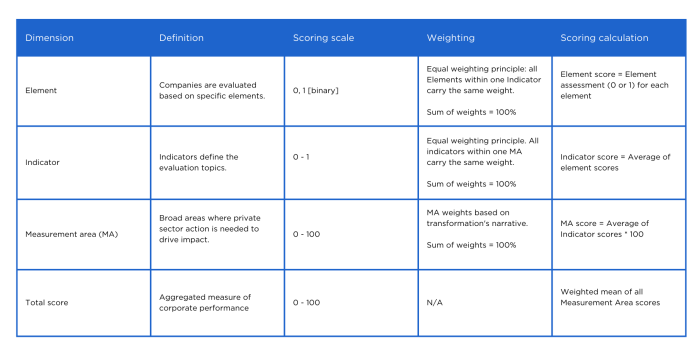
Note: If an element is not applicable to a company, the weight of that element is distributed equally across the applicable elements of the indicator. Similarly, if an indicator is not applicable to a company, the weight will be redistributed across all applicable indicators within the respective MA.
Non-applicability is avoided where possible. If non-applicability is applied, a clear rationale is stated.
Applied Example
This example shows how a company’s performance is evaluated according to our scoring approach. Chosen numbers are illustrative to produce a simplified calculation example.
Example benchmark structure: Company A is assessed against Benchmark B
Measurement Areas:
- Benchmark B is comprised of two Measurement Areas (MA): MA1, MA2
- MA1: Weight = 40%
- MA2: Weight = 60%
Indicators:
- MA1 has four indicators: I1, I2, I3, I4
- MA2 has five indicators
- All indicators are equally weighted within a measurement area
Elements:
- Each indicator comprises of several elements
- Elements are assigned a score of 0 (unmet) or 1 (met) depending on whether Company A meets the element criteria
- All elements are equally weighted within an indicator
Scoring calculations:
Indicator score:
- The indicator score is calculated as the average of all element scores within each respective indicator
- Indicator 1 (I1) has four elements. Company A meets the first, third and fourth elements. The second element is unmet.
- Indicator 2 (I2) has three elements. Company A meets the second and third elements. The first element is unmet.
- Indicator score = Sum of element scores / Number of elements
- I1 = (1+0+1+1)/4 = 3/4
- I2 = (0+1+1)/3= 2/3
Measurement Area score:
- The Measurement Area score is the average of the indicator scores multiplied by 100
- Measurement Area score = (Sum of indicator scores / Number of indicators) * 100
- MA1 = (3/4 (I1) + 2/3 (I2) + 1 + 1/2)/4 * 100 = 72.9
- MA2 = (1 + 1/2 + 1/5 + 1/2 + 3/5)/5 * 100 = 56.0
Total score:
- The total score for Company A is the weighted mean of all MA scores.
- Total score = (MA1 score * weight of MA1) + (MA2 score * weight of MA2)
- Total score = (72.9 * 40%)+ (56.0 * 60%) = 29.2 + 33.6 = 62.8
Benchmark Methodologies














Download the Scoring Approach
The WBA scoring approach is available in both English and Japanese, with thanks to CRT Japan for the latter translation.

Subscribe to stay informed on our work
Keep up to date with all the latest from World Benchmarking Alliance